
Why a Higher Google Ads CPC Is Not Always a Bad Thing
Everybody watches CPC, or cost per click.
Your Google Ads cost per click goes from $5 to $7, and suddenly it feels like the account is falling apart. You start lowering bids, cutting keywords, and tightening targeting in an effort to get that CPC back down.
But here is the truth: CPC is mostly irrelevant.
Not completely irrelevant. It is still a useful diagnostic metric. But it is one of the least useful metrics to optimize for by itself.
A cheap click that never turns into revenue is expensive. An expensive click that turns into a great customer is cheap.
Google Ads is not a contest to buy the cheapest traffic possible. It is a tool to help your business get profitable customers.
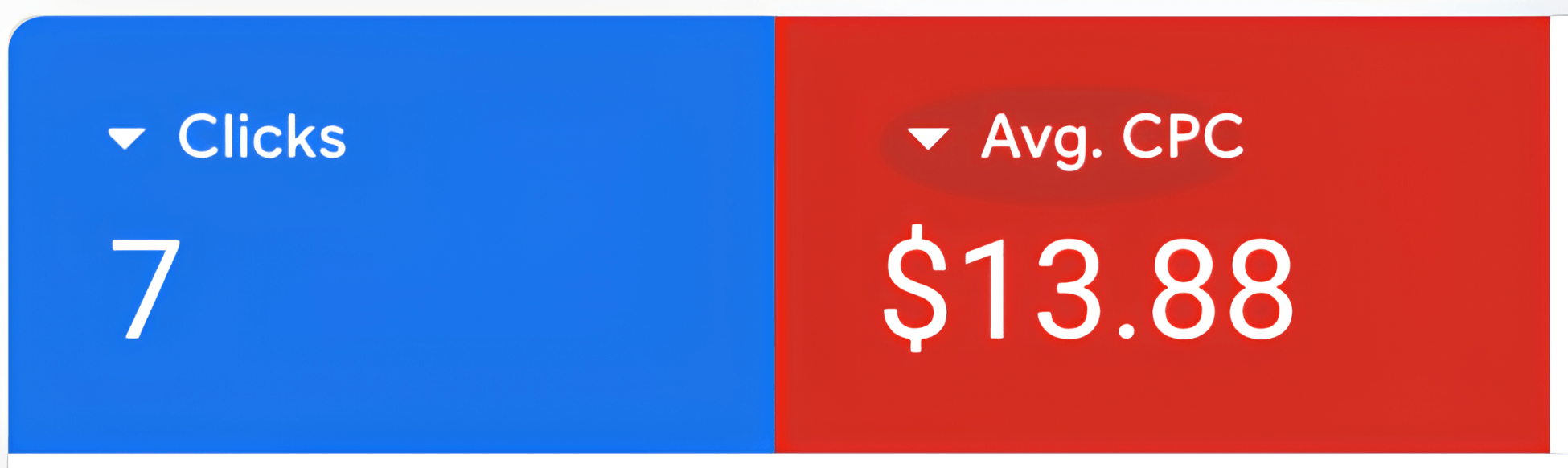
The Question Is Not “How Much Did This Click Cost?”
Google Ads is a numbers game. If every click had the same quality, I would choose a lower CPC over a higher CPC every time.
But clicks are not equal.
Some searches come from people who are just researching. Some come from people ready to buy. Some keywords produce low-quality leads. Others generate customers who spend more, close faster, and stick around longer.
So instead of asking:
“How much did I pay for this click?”
Ask this:
“What did I get from this click?”
A $12 Click Can Be Better Than a $3 Click
Let’s look at a simple example.
| Metric | Keyword A | Keyword B |
|---|---|---|
| Cost per click | $3 | $12 |
| Conversion rate | 1% | 10% |
| Clicks needed for one customer | 100 | 10 |
| Cost to acquire one customer | $300 | $120 |
| Customer value | $100 | $500 |
Keyword A looks great at first because the CPC is only $3. But it converts at 1%.
That means you need around 100 clicks to get one customer. At $3 per click, you spend $300 to acquire a customer worth $100. That is not a cheap keyword. It is a losing keyword.
Now look at Keyword B.
It costs $12 per click, which sounds expensive. But it converts at 10%, so you only need about 10 clicks to generate a customer. Your acquisition cost is $120, and that customer is worth $500.
Which keyword would you rather get more of?
Keyword B every single time.
If you optimized only for a lower CPC, you could easily cut the keyword that is driving the best results in the account.
Cheap Clicks Are Not Automatically Good Clicks
If your only goal were to get clicks as cheaply as possible, you could probably find traffic for pennies.
But cheap traffic is not the same thing as valuable traffic.
A $1 click that produces nothing is not cheap. A $50 click that brings in a $10,000 customer can be an incredible deal.
That is why CPC needs context. You need to look at what happens after someone clicks.
Why Does Google Ads CPC Change?
A rising CPC does not automatically mean something is wrong. CPCs can change for many reasons, including:
- Auction competition from other advertisers
- Changes in search demand or seasonality
- Different search queries triggering your ads
- Changes in device mix, such as more mobile traffic
- Location and time-of-day performance differences
- Quality Score and ad relevance
- Budget changes from competitors
- Google’s automated bidding decisions
If you use Smart Bidding, such as Maximize Conversions, Target CPA, or Target ROAS, Google is not trying to find the cheapest clicks available.
It is trying to enter auctions where it believes you have the best chance of getting a conversion or reaching your value goal.
Those clicks may cost more. That is fine if the additional cost produces better leads, more sales, stronger return on ad spend, or more profit.
When a Higher CPC Is Actually a Good Sign
I have managed Google Ads campaigns for more than 16 years and over $70 million in ad spend. I have seen plenty of situations where CPCs increased while campaign performance improved.
For example, a campaign may start appearing more often for high-intent searches. Those auctions may be more competitive, so the CPC rises. But if those searchers are more likely to become customers, your conversion rate, revenue, or return on ad spend can improve at the same time.
In that situation, trying to force CPC back down could hurt the account.
When CPC increases, do not immediately ask:
“What can I do to lower this?”
Ask these questions instead:
- Why did CPC increase?
- Did conversion rate change?
- Did cost per lead or cost per acquisition change?
- Are the leads still qualified?
- Did revenue, profit, or return on ad spend improve?
- Are we getting more valuable customers?
Metrics That Matter More Than CPC
Your best metrics depend on how your business makes money.
For Lead Generation Businesses
- Cost per qualified lead
- Cost per acquisition
- Lead-to-sale rate
- Customer acquisition cost
- Revenue per lead
- Profit per customer
For Ecommerce Businesses
- Conversion value
- Return on ad spend (ROAS)
- Profit or contribution margin
- Customer acquisition cost
- Average order value
- Lifetime customer value
CPC still matters, but it should be used as a diagnostic metric rather than the main goal.
If CPC rises and your cost per acquisition, ROAS, or profit gets worse, then you have something worth investigating. But if CPC rises while the business results improve, that higher CPC may be helping you—not hurting you.
Should You Ever Try to Lower Your CPC?
Yes, but only when lower CPC supports better overall results.
You may want to investigate high CPCs when:
- Your cost per acquisition is above a profitable level
- Your return on ad spend is declining
- Your lead quality is getting worse
- You are paying for irrelevant search terms
- Your conversion rate has dropped significantly
- Your bids or budgets are pushing spend into low-performing traffic
The goal is not to lower CPC just because it went up. The goal is to improve profitable performance.
The Bottom Line
Google Ads is not a contest to get the cheapest clicks possible.
A low CPC can be a warning sign if the traffic does not convert. A high CPC can be completely acceptable if it produces profitable customers.
The next time your CPC increases, do not panic. Look beyond the click cost and ask what changed in the rest of the funnel.
Stop optimizing for cheap clicks. Start optimizing for profitable clicks.
If you want help improving your Google Ads campaigns, check out more of my Google Ads resources and subscribe to my YouTube channel for weekly Google Ads strategies, tips, and campaign breakdowns.
Stop Wasting Money Marketing Your Business Online
Join my email list to get your copy of the Online Marketing Jumpstart PDF!
We hate SPAM. We will never sell your information, for any reason.
Written By:

